Field hockey is a worldwide team game that is rapid and proficient. This sport is played by millions of people in schools, clubs and international competitions. It is necessary that beginners, players and fans who would enjoy the game in the field of hockey know the field hockey rules
It is a game of competition between two teams, where they strive to win by scoring points by hitting a small hard ball into a goal of the opponent using a curved stick. Even though the gameplay itself might appear easy, the rules of field hockey consist of a number of technical points that regulate the actions of players, equipment, fouls, and approaches to scoring.
This all-inclusive guide will educate you on the most vital field hockey regulations, the structure of the match, discipline, equipment, and the overall structure of the game.
What is Field Hockey?
Field hockey is a team game and is played on turf or grass. Two teams are playing using hockey sticks to pass a ball and score some points.
The official field hockey rules provide that there are eleven players on each side. The essence of the game is simple: to win before the end of the match with the actual number of goals than the opponent.
Players are also not allowed to use their feet or hands to control the ball as is the case with some other sports. Rather, they have to play with the flat side of their stick. As a result of such a limitation, the game requires high levels of stick control, speed, team work and tactical awareness.
Basic Structure of the Game
Games in contemporary times are held according to a particular pattern which makes sure that the game is conducted in an orderly fashion.
- Every team consists of 11 players.
- Each team will consist of 1 goalkeeper and the rest will be on the field.
- There will be four quarters in a game, each lasting 15 minutes.
- Two-minutes breaks will be provided between each quarter.
- The break will be 10 minutes.
- Substitution is allowed at any time as needed in the game.
Unlimited substitution ensures that there is constant action and pace in the game.
The Playing Field Dimensions
Size of the field greatly influences the play on the ground.
As per the regulations of field hockey, standard sizes of a field include:
- Field length – 91.4 m
- Field width – 55 m
- Width of the goal – 3.66 m
- Height of the goal – 2.14 m
Every goal area will have one shooting circle where the ball has to be struck to be counted as a goal.
Here is a summary of the size of the field.
| Field Component | Measurement |
| Field Length | 91.4 meters |
| Field Width | 55 meters |
| Goal Width | 3.66 meters |
| Goal Height | 2.14 meters |
| Shooting Circle Radius | 14.63 meters |
These measurements are part of official field hockey rules used in international competitions.
Team Composition and Player Positions
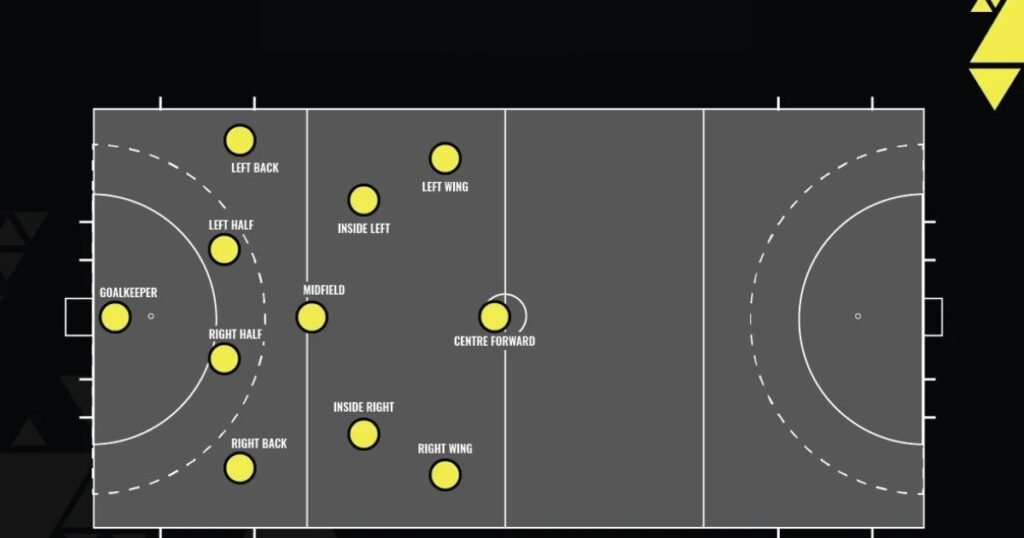
The appropriate team formation would aid in the balance between defense and attack. The rules of field hockey enable teams to form various patterns based on their strategy.
Typical positions include:
- Goalkeeper: The goalkeeper protects the goal and is the only player that can protect the ball by his body in the circle.
- Defenders: Defenders stay near their goal and deprive the other team a goal.Midfielders: Midfielders are the game possessors..Midfielders: Midfielders control the flow of the game.
- Midfielders: Midfielders control the flow of the game. They relate defense and attack and assist them both.
- Forwards: Forwards focus on creating scoring opportunities and putting pressure on the opponent’s defense..
It can be in 4-3-3 or 3-4-3 formation, depending on the tactics of the team.
Ball Handling Rules
The sport has stringent rules on ball handling. The rules of field hockey are clear on the ways that can be used by players to touch the ball.
Players have to adhere to the following key guidelines:
- The stick is only able to hit the ball on the flat surface.
- Players are not allowed to deliberately kick the ball.
- One does not take the stick too high and above the shoulders.
- Players are not allowed to touch hands or body to touch the ball.
These field hockey regulations safeguard players against injuries and fair play in the game.
Due to the nature of the stick being flat and curved in a side, players need to have good technical abilities so that they could have control whilst playing at a high speed.
The Card System in Field Hockey Rules
As in most other sports, a card system is used to maintain discipline. There are three referee cards in the field of hockey games.
- Green Card: A green card is a warning. The player will be required to exit the field after 2 minutes.
- Yellow Card: A yellow card leads to a temporary suspension, normally of 5 to 10 minutes.
- Red Card: A red card results in being kicked off forever.
These field hockey regulations discourage rough play and uphold respect among players.
No Offside Field Hockey Rules
The lack of offside can be considered one of the most peculiar features of the sport. Under field hockey regulations, any player is allowed to move anywhere on the field.
This rule brings a number of benefits:
- Faster attacking opportunities
- More open gameplay
- Creative tactical strategies
Because there is no limit on offside, the team will try to bring their striker closer to the opponent’s goal to create a chance of scoring a goal.
What is a Penalty Corner
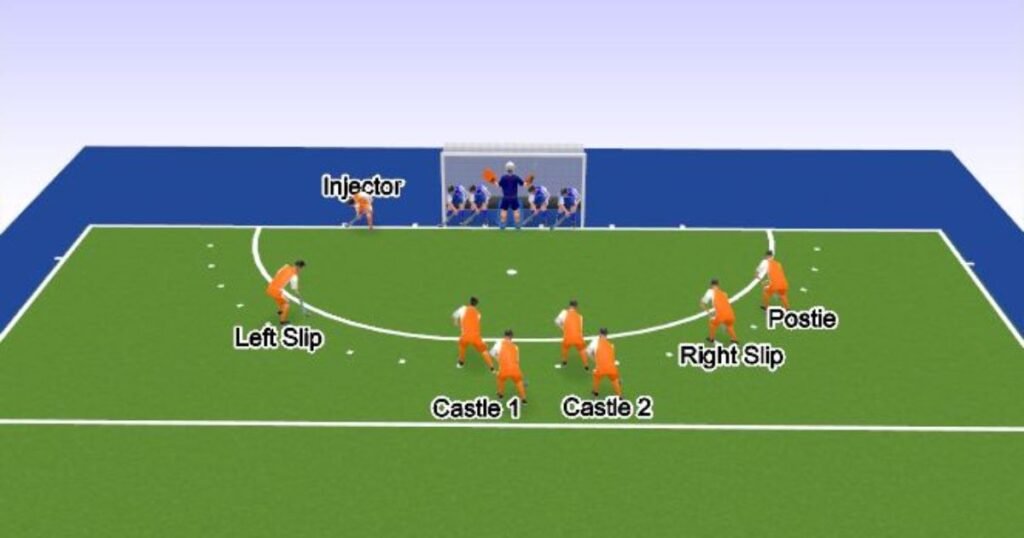
There is nothing more thrilling than a penalty corner in the field hockey match. According to the field hockey regulations, a penalty corner is awarded if any foul is committed inside the circle or if the ball crosses the backline after being struck by the defending side.
When there is a penalty corner:
- There are five players who are on the offensive.
- Four defenders and the goalkeeper defend the goal.
- The ball is moved by pushing it out of the back line towards other players outside the circle.
Special strategies in this case are often practised by teams since penalty corners provide good scoring chances.
Penalty Stroke Rule
The most severe punishment in the sport is a penalty stroke. By the field hockey rules a penalty stroke is awarded by referees when a clear goal is not allowed by a defender who commits a foul.
The shot is made at 6.4 meters in front of the goal.
Only the striker and goalkeeper participate in this situation. Due to the close distance, penalty strokes often lead to goals.
Common Fouls in Field Hockey Rules
There are a number of fouls that are common during matches. These fouls are outlined in the field hockey rules to promote a safe competition.
Some of the fouls that are most prevalent are:
- High Stick
A player elevates the stick too high in the air which is above the shoulder.
2. Obstruction
A player guards an opponent against access to the ball with the help of the body.
3. Dangerous Play
One of the players is engaged in actions that would harm others.
4. Back Stick
The ball is hit by a player with the curved part of the stick.
Tackling from Behind
The back player attacks the opponent in an unequal manner.
In case of such fouls, referees tend to give a free hit to the other team.
Mandatory Equipment for Players
Safety equipment is extremely important in hockey. The field hockey rules require players to use specific gear.
Field Players Equipment
- Hockey stick (maximum 105 cm)
- Shin guards
- Mouthguard
- Sports shoes with grip
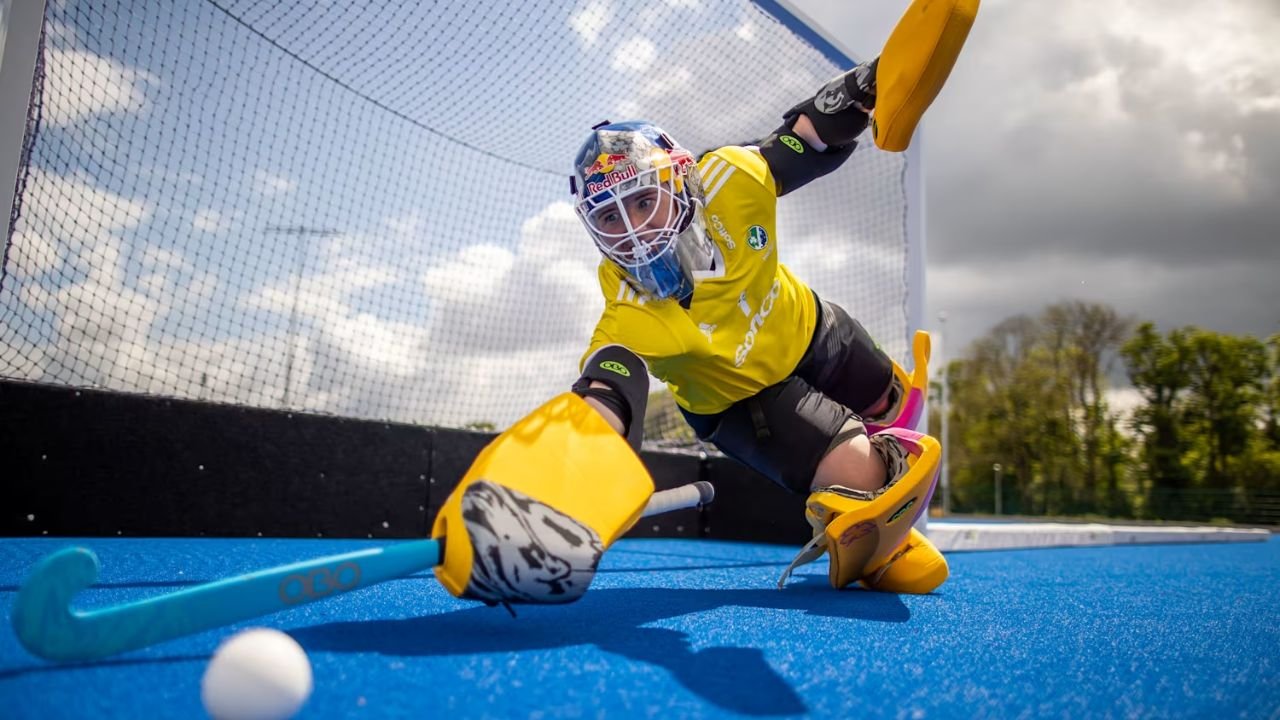
Goalkeeper Equipment
- Helmet with face protection
- Chest protector
- Leg guards
- Gloves
- Foot guards
Goalkeepers wear more protective equipment because they face powerful shots during the game.
Field Hockey vs Ice Hockey
Although both sports share similar names, they have several differences.
| Aspect | Field Hockey | Ice Hockey |
| Surface | Grass or turf | Ice rink |
| Players per team | 11 players | 6 players |
| Match duration | 4 quarters of 15 minutes | 3 periods of 20 minutes |
| Game object | Hard plastic ball | Rubber puck |
| Offside rule | No offside | Offside exists |
| Physical contact | Limited | Allowed |
Regardless of these differences, teamwork, strategy, speed and good coordination are essential in both sports.
Why Understanding Field Hockey Rules Is Important
Being familiar with field hockey rules enhances the fun of players and viewers. Having the knowledge of these rules will enable people to understand the game better and appreciate the tactics employed by the teams.
Newcomers into the sport would be well advised to be familiar with the field hockey rules to prevent accidents during on field play and also to know how to play the game properly. Meanwhile, the coaches use them in the training of their players.
Professional referees are strict when enforcing field hockey rules.
Conclusion
Field hockey is a very thrilling game that involves speed, strategy and team work. Knowing the fundamentals of field hockey rules helps players play better, and the spectators to appreciate the game more.
The game has 11 players on each side, 15-minute quarters, and a huge field that is 91.4 x 55 meters. Players should have to play with the flat part of the stick, no body contact with the ball and score goals within the shooting circle.
Also Read About: Field Hockey Turf Shoes | Field Hockey Sticks