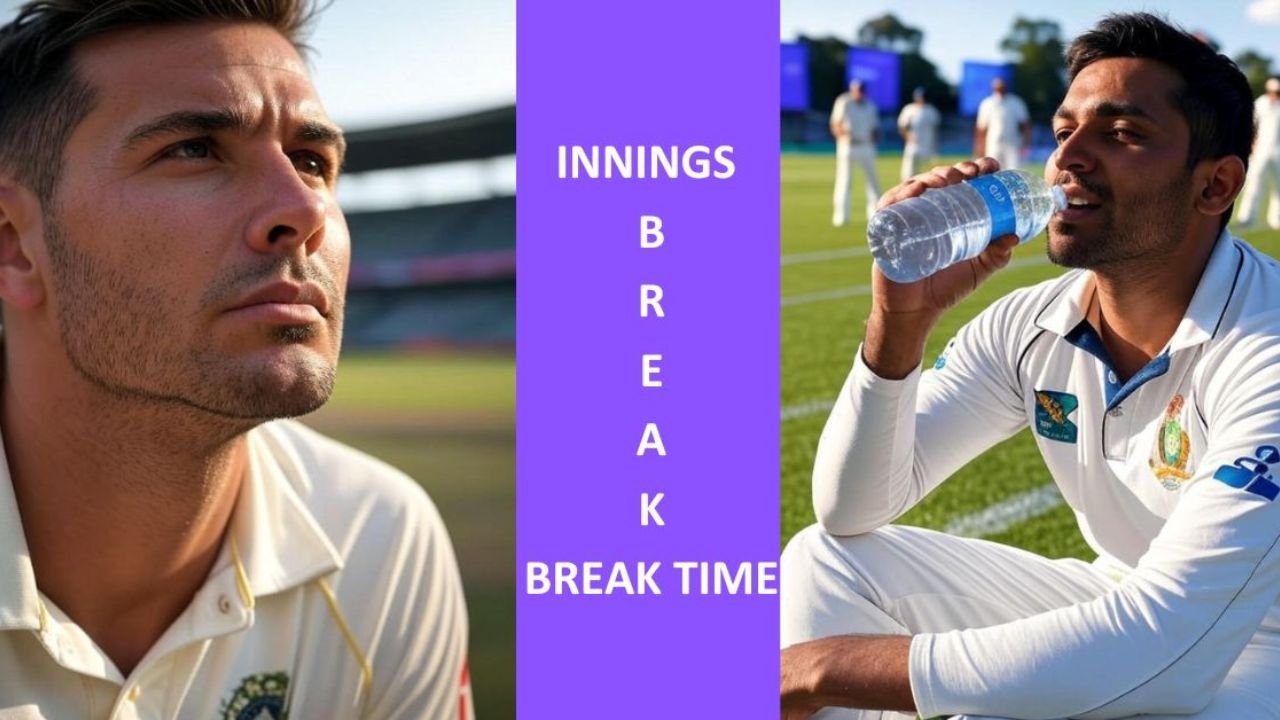
Cricket fans watching a one-day international often notice the same pattern. The batting of the first team is called, and the players get off the field, and the show passes to the studio commentary on what seems to be an eternity, then the chase. That hiatus has got a name, a fixed time, and a rulebook behind it. Innings break time in ODI game is not an accident, and the advertiser is used in the interlude. It is a predetermined period enshrined in formal playing set-ups, and it is what defines the overall operation of the match day.
Whoever has been a follower of a one-day international must be aware that this break is more weighty than a mere pit stop. Racers tied to the clock stand by the pitch repairing it, physios carry out on the bowlers who are exhausted, and coaches pass over statistics as the second innings begins. Understanding how long this break lasts, why it exists, and how it can shrink under pressure helps you follow an ODI match with far more context than most casual viewers ever pick up.
Innings Break Time in ODI: The Official Duration
The standard innings break time in ODI cricket is 45 minutes. This period starts the instant the umpire announces Time at the close of the first innings and finishes at the announcement of Play at the commencement of the second. The same window is used to watch every bilateral series and every major tournament, meaning that a fan in Mumbai and a fan in London are watching the same duration of break when there is an international game in one day.
This figure of 45 minutes did not come out of the air either. It was put at last by cricket boards because a 50-over game wears a player out and requires a decent ground overhaul, which can only be accomplished with a longer recess.
What Innings Break Time in ODI Actually Covers?
People often assume the break is only for players to rest, but three separate groups depend on those 45 minutes for very different reasons. Players require rest, ground staff require access to the pitch, and commercial content only requires airtime by the broadcasters.
A fast bowler out of a ten-over would need some baby drunk and immediate physio cover before fieldwork would be undertaken once more. In the meantime, the pitch has footprints and rubs at the edge of the crease, which have to be evened out by the ground staff so that everyone is even. With the still-running product, which garners millions of viewers, the broadcasters attract their advertisements and panels of experts without cutting on live action.
Why the Timing Rule Exists in the First Place
This uniformity ensures that there is uniformity throughout the format and tournaments on the basis of the break. It might make the host broadcasters take a pause to get more advertisement income than the other host broadcaster will finish before the time runs out, and the players and the spectators will have a different experience.
- Keeps match scheduling predictable across different countries and boards
- Gives broadcasters a reliable, uniform commercial window
- Protects player welfare with a guaranteed recovery period
- Allows ground staff a fixed slot to maintain pitch quality
What Do the ICC Playing Conditions Say?
In its ODI Playing Conditions, the ICC considers the innings break to ensure that the same match conditions are applied internationally. In the usual game, there is a 45-minute break between innings for the team. The match referee, however, has the prerogative of shortening the interval whereby the schedule is disrupted by rain, bad light, or other delays. This flexibility aids officials in delivering the match within the given playing time, and at the same time, the officials ensure that the playing facilities are favorable to both teams.
Why One Day International Cricket Needs a Longer Break
On average, a T20 innings takes approximately 80 minutes, and so the players have minimal time to rest and interchange positions. An international innings, even a one-day, lasts longer than three hours, and the additional physical and psychological burden requires a more significant rest period.
Consider a batting side that has batted first; the team needs to protect 280 runs. Their bowlers must now have a new strategy, an analysis of the behaviour of the pitch in varying light, and also debate regarding the field set-up over the next three and a half hours. None of such technical effort occurs in the right manner within ten minutes, and that is the reason why an ODI game secures a much bigger distance than a shortened one.
How the Break Fits Into an ODI Match Timeline
Having an understanding of the exact form of the match day can be used to show why broadcasters strategize over this gap so well. An entire one-day international, ball to ball, will take you seven to eight hours to play, including the two innings and the break in between.
| Phase | Time |
| First Innings | ~3 hours 30 minutes |
| Innings Break | 45 minutes |
| Second Innings | ~3 hours 30 minutes |
Which means the best time for a fully compliant ODI game is around 7–8 hours. This timeline also explains why day-night matches feel rushed toward the end. Since the innings break time in ODI stays fixed at 45 minutes regardless of the start time, any delay earlier in the day pushes the finish deeper into the night.
When the ODI Break Gets Shorter
Match officials do not treat 45 minutes as untouchable. Weather delays, slow over rates, and tournament scheduling pressure can all force a shorter break, though never below a strict minimum.
The most typical trigger is rain. When a storm swallows playing time before the completion of the first innings, then the referee of the match re-calculates the interval to ensure that the completion of the entire match on the same day is still possible. The duration of a break may be reduced to 30, 20, or even 10 minutes in case of a very rainy match due to the loss of time.
Situations That Trigger a Shorter Break
- Rain delays reduce available playing time before the first innings ends
- Day-night matches are running behind schedule due to slow over rates
- Tight tournament windows where back-to-back matches share one venue
- Requests from the match referee to protect the overall finish time
Picture a rain-hit chase where the first innings ends late in the evening. Referees cannot allow the 45-minute break without moving the second innings beyond a reasonable end time, and so they decide to cut the break whilst still providing both teams with a reasonable reset.
Innings Break Time in ODI vs T20 and Test Cricket
Comparison of the break lengths in different formats reveals the similarity between interval duration and the duration and speed of the game. Shorter formats have fewer resets, and Test cricket breaks vary in a day-long break.
| Format | Break Duration | Notes |
| T20 (including T20I and IPL) | 10 minutes | Fast-paced format, quick turnaround needed |
| ODI (One Day International) | 45 minutes | Longest single interval of any limited-overs format |
| Test Match (change of innings) | 10 minutes | Separate from lunch and tea breaks |
| Test Match Lunch Break | 40 minutes | Fixed session break, not tied to innings end |
| Test Match Tea Break | 20 minutes | Shorter than lunch, later in the day |
The gap between formats is not just a scheduling quirk. The reason why a T20 team can almost change the direction of batting to the field of it within seconds is that the tactical planning is limited to the span of seconds rather than hours, and the ODI match requires a total shift in mental approach due to the magnitude of a 50-over chase.
Drinks Break and Innings Break Are Not the Same Thing
These two stoppages are often confused by the new spectators, but they have entirely different purposes when it comes to a one-day international. A drinks break occurs during the middle of an innings, and only takes a few minutes and does not involve any work with ground staff.
There are two breaks where drinking is permitted per innings, spaced between about an hour and ten minutes, where players get a brief opportunity to refresh themselves and be briefly reminded of tactics by those in the dugout. Inning break, on the contrary, is one of the complete operational rest times marked with pitch repair, player rest, and real tactical planning between the captains and coaches.
Key Differences Between the Two Breaks
- Breaks during drinks last between a few minutes; during the innings last as long as 45 minutes.
- Drinks breaks are made up of middle-innings; the innings break occurs once, between innings.
- During the economy, the ground staff never work during drinks breaks; they work only during the innings break.
- The innings break is a commercial window as opposed to the short drinks break taken by broadcasters.
What Really Happens on the Ground During the Break
Viewers watching from home only see empty grounds and studio panels, yet a huge amount of coordinated work happens behind the scenes during those 45 minutes. Ground staff rush around to maintain the bowler footholes, sweeps, and inspections of boundary markers, and then the surface is again inspected by the umpires. Bowling economy rates and pitch data are brought up by coaches and analysts to decide a plan of defense or a chase.
Meanwhile, physios treat any niggles among bowlers who have gone through their whole responsibility of bowling outs, as an exhausted fast bowler who comes back too soon could be prone to injury later in the day. This synchronization is why there is seldom a time that broadcasters take full 45 minutes of pure commercial materials. When you deduct the time required to prepare the ground and the time required to place players on the ground, the real free broadcast time will be reduced to a smaller size of about 20-25 minutes.
Innings Break Time in ODI World Cup and Major Tournaments
Fans sometimes assume marquee events like the World Cup follow a different clock, but the innings break time in ODI World Cup matches stays identical to that of any bilateral series. The same 45-minute rule applies whether it is a group stage fixture or a final.
The only thing that is different at major tournaments is the content of the broadcast. Networks may also invite former players to do lengthy interviews or conduct tournament-themed advertisement spots during big matches, but none of this prolongs the standard length of play (45 minutes).
Common Confusions Fans Have About ODI Match Timing
There are a few misconceptions that continue to persist in the minds of the ordinary viewers, and debunking them makes the overall viewing experience that much more fun.
- Assuming the interval always lasts exactly 45 minutes, even during rain delays
- Confusing the innings break with the shorter mid-innings drinks break
- Believing World Cup matches follow a separate, longer interval rule
- Thinking a shortened break during a rain-hit match is a broadcast mistake rather than a rule-based decision
Conclusion
That 45-minute pause between innings carries far more weight than most viewers realize. It protects tired players, provides space crew a real opportunity to repair the playing field, and keeps broadcasters afloat, with a fair commercial window, and is flexible enough to respond when it is necessary to take a shorter break because of rain or scheduling pressure. When a one-day international halts after the first part of the game, the next time you will know the exact reason as to why that moment occurs and how the door swings at each side, connecting all that goes on in the field and beyond the field.
Also Read About: Best Captain in the IPL: Ranking the Leaders Who Built Champion Teams
No 1 Fixing Team in IPL: Truth, Controversies, and History Explained